0964 466 014




Critical Thinking: Concept and Ways for Students to Cultivate It
Critical thinking is a higher‐level thinking skill that enables people to analyze, evaluate, and critique information in a logical, objective manner. In a world that is increasingly complex and multi-dimensional, critical thinking becomes an important factor helping each individual avoid falling into emotional ways of thinking, recognize misinformation, and make sound decisions.


- What is Critical Thinking?
- What Role Does Critical Thinking Play in Learning?
- What Types of Critical Thinking Are There?
- Six Developmental Levels in Critical Thinking
- What Skills Should Parents and Schools Support in Students?
- Suggested Books for Students to Develop Critical Thinking
- SNA Walks Alongside Students in Developing Critical Thinking
- Frequently Asked Questions
What is Critical Thinking?
What does “critique/criticism” mean?
“Critique” is usually understood as expressing an opposing opinion, analyzing, evaluating a matter based on reasoning and concrete evidence. It is not denying or opposing sensibly; rather, it is the thinking process to clarify, supplement, or adjust viewpoints to approach the truth in a more comprehensive way.
What is critical thinking?
Critical thinking is the ability to analyze information objectively, to ask questions, evaluate evidence, identify assumptions, and draw reasoned conclusions. Students with critical thinking do not passively absorb knowledge but know how to compare, contrast, and form independent opinions. This is the foundation for students to learn effectively and to grow in thinking.
>>> Related articles:
- Global Citizen: Definition, Criteria, and Essential Skills
- Top High-Demand and Promising Careers of the Future
What Role Does Critical Thinking Play in Learning?
In the school environment, critical thinking helps students not only understand lessons more deeply but also develop essential 21st‐century skills:
- Improves capacity for analysis and reasoning: Students learn structured thinking, clear and logical arguments.
- Encourages creativity: Critical thinking helps students keep asking “Why?” and “What if…?”, sparking new ideas.
- Supports effective knowledge acquisition: Instead of rote memorization, students understand the essence of issues and remember longer through the process of analyzing and critiquing.
- Builds confidence: When able to defend their viewpoints with strong arguments, students feel more confident speaking up, debating, or presenting ideas.
- Prepares students for international academic settings: Critical thinking is required in modern educational programs such as IB, AP, or foreign universities.
What Types of Critical Thinking Are There?
Critical thinking can be classified into different types depending on goals and how it is applied:
- Logical critical thinking: Based on sound reasoning, reasonable inference, and verifying evidence to reach conclusions.
- Creative critical thinking: Combining logical analysis with “outside the box” thinking to produce new solutions for old problems.
- Ethical critical thinking: Evaluating issues from multiple angles, considering both individual and community benefits, between right and wrong.
- Strategic critical thinking: Using thinking tools to make long‐term decisions, especially in complex situations with many factors.
>>> Related article: Logical Thinking: Definition and How to Train Your Mind for Maximum Potential
Six Developmental Levels in Critical Thinking
According to the research by Linda Elder and Richard Paul – leading experts in the field of critical thinking education – the process of developing critical thinking can be divided into six levels:
- The Unreflective Thinker – A person who thinks without reflection. Students at this level tend to receive information passively, not yet aware of the need to analyze, evaluate, or verify information.
- The Challenged Thinker – Someone who begins to realize that their thinking may contain errors, bias, or deficiencies, but doesn’t yet know how to fix them or lacks tools to improve.
- The Beginning Thinker – A student who starts self‐evaluating and adjusting their thinking, knows how to use some techniques like asking questions or analyzing reasoning. However, this is not yet done regularly or systematically.
- The Practical Thinker – Consistently practices critical thinking, able to identify biases, logical fallacies, and shortcomings in their own thinking and that of others.
- The Advanced Thinker – Regularly analyzes, evaluates, and improves thinking. Has the ability to self‐learn, self‐evaluate, and make decisions based on sound reasoning and real data.
- The Master Thinker – Critical thinking becomes a natural part of thought and action. Can analyze and critique at a deep level, and also inspire others to develop independent thinking.
What Skills Should Parents and Schools Support in Students?
To help children develop critical thinking, parents and schools need to:
- Encourage questioning: Always respect and invite children to ask “Why?” and “What if…?”.
- Avoid imposing thinking: Avoid forcing the child to believe something just because “adults say so.”
- Teach children to analyze and compare: Give assignments or situations that require looking at multiple sides of an issue.
- Create a healthy debating environment: Let children express their opinions, debate with peers or teachers in a respectful and arguments‐based manner.
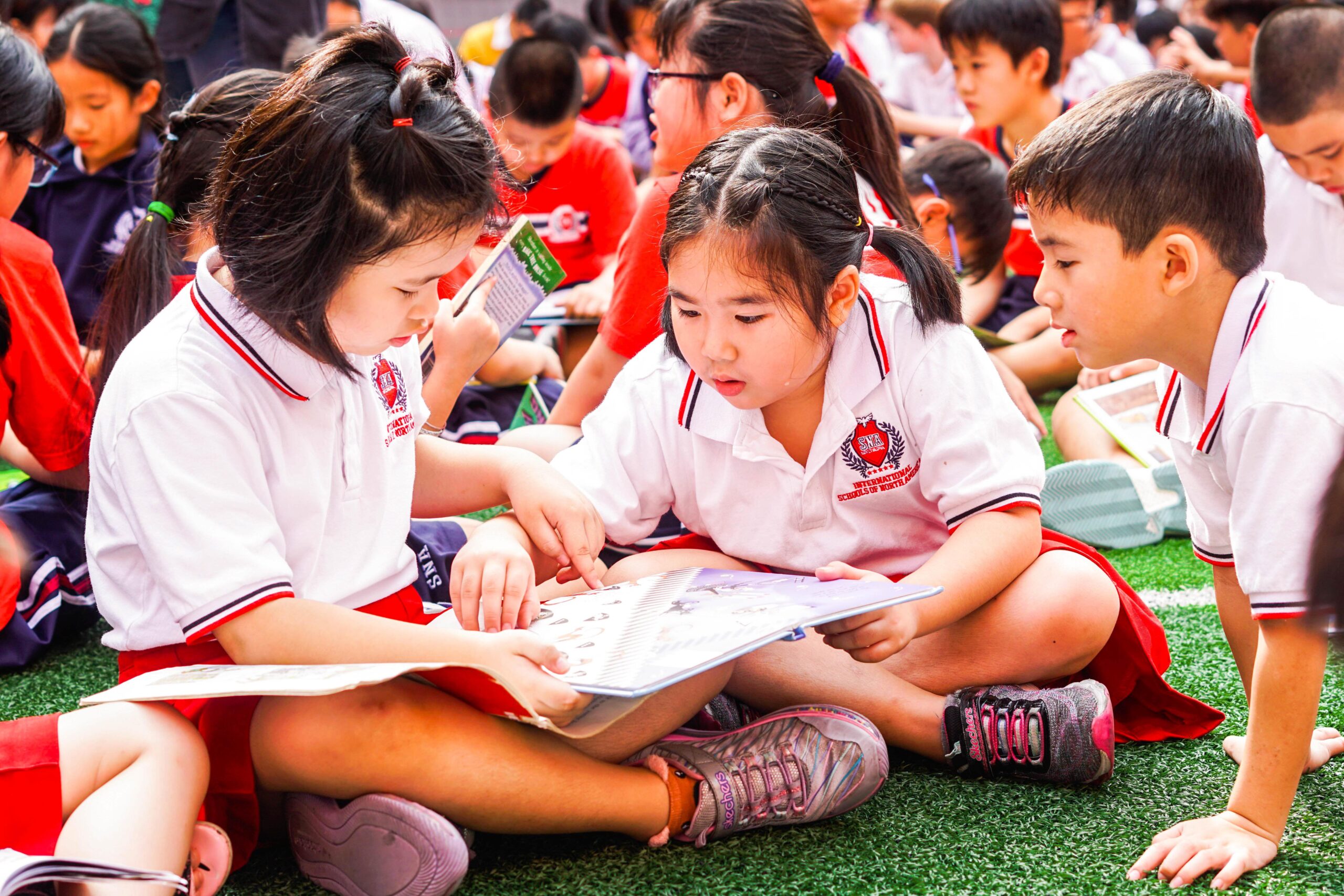
- Provide quality materials: Let children read books, watch documentaries, access credible sources to learn how to verify information.
Suggested Books for Students to Develop Critical Thinking
Here are some good books for middle and high school students, and for parents who wish to accompany their children:
- Thinking, Fast and Slow – Daniel Kahneman
- Critical Thinking – Richard Paul & Linda Elder
- Out of the Box: 101 Creative Thinking Ideas – Rob Eastaway
- Factfulness – Hans Rosling
- Don’t Believe Everything You Think – Thomas E. Kida
SNA Walks Alongside Students in Developing Critical Thinking
Critical thinking isn’t just a skill, but a thinking habit that needs to be nurtured daily. At SNA Saigon South – one of the few full IB schools in Vietnam – the cultivation of critical thinking is integrated continuously in students’ learning journey from Primary (PYP) to High School (DP).
- IB Program encourages critical questioning and multidimensional learning
One of the standout features of the International Baccalaureate (IB) program at SNA is the learning philosophy centered around the question “why”. From PYP to DP, students are encouraged to ask open questions, challenge assumptions, explore many perspectives, and develop independent reasoning. - Open learning environment helps students confidently express viewpoints
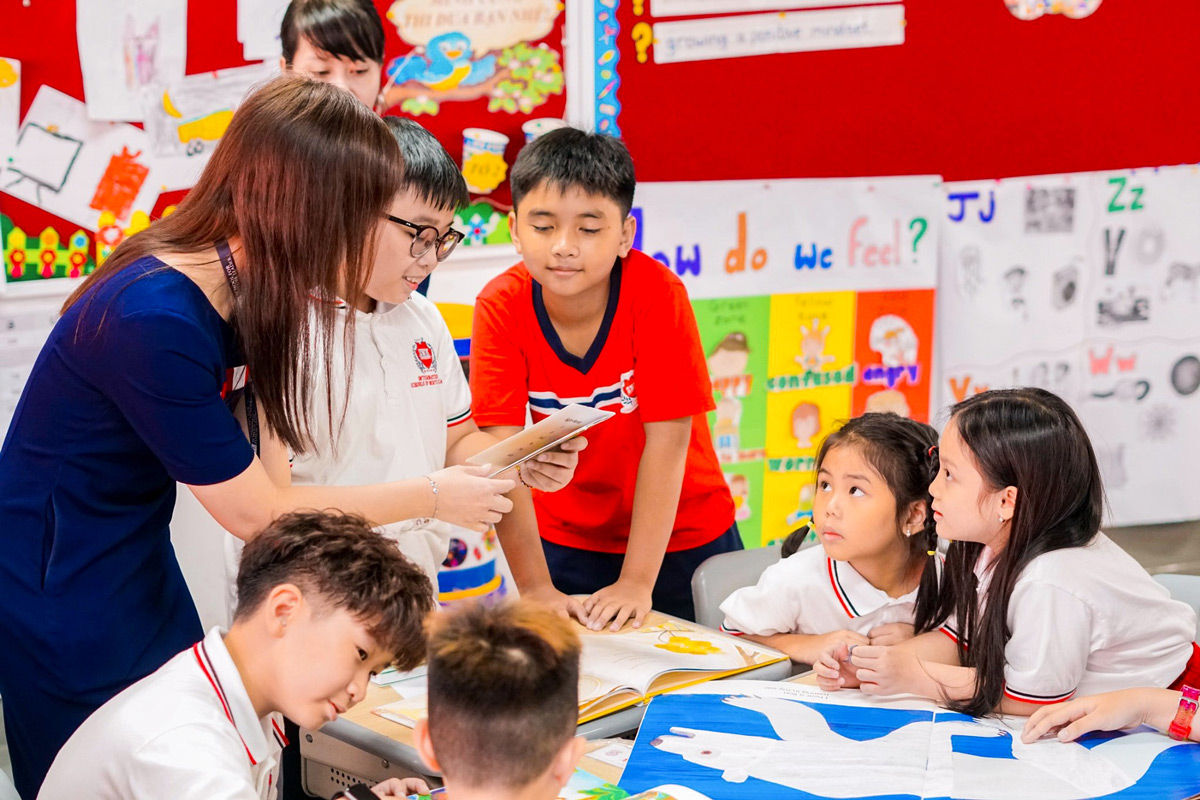
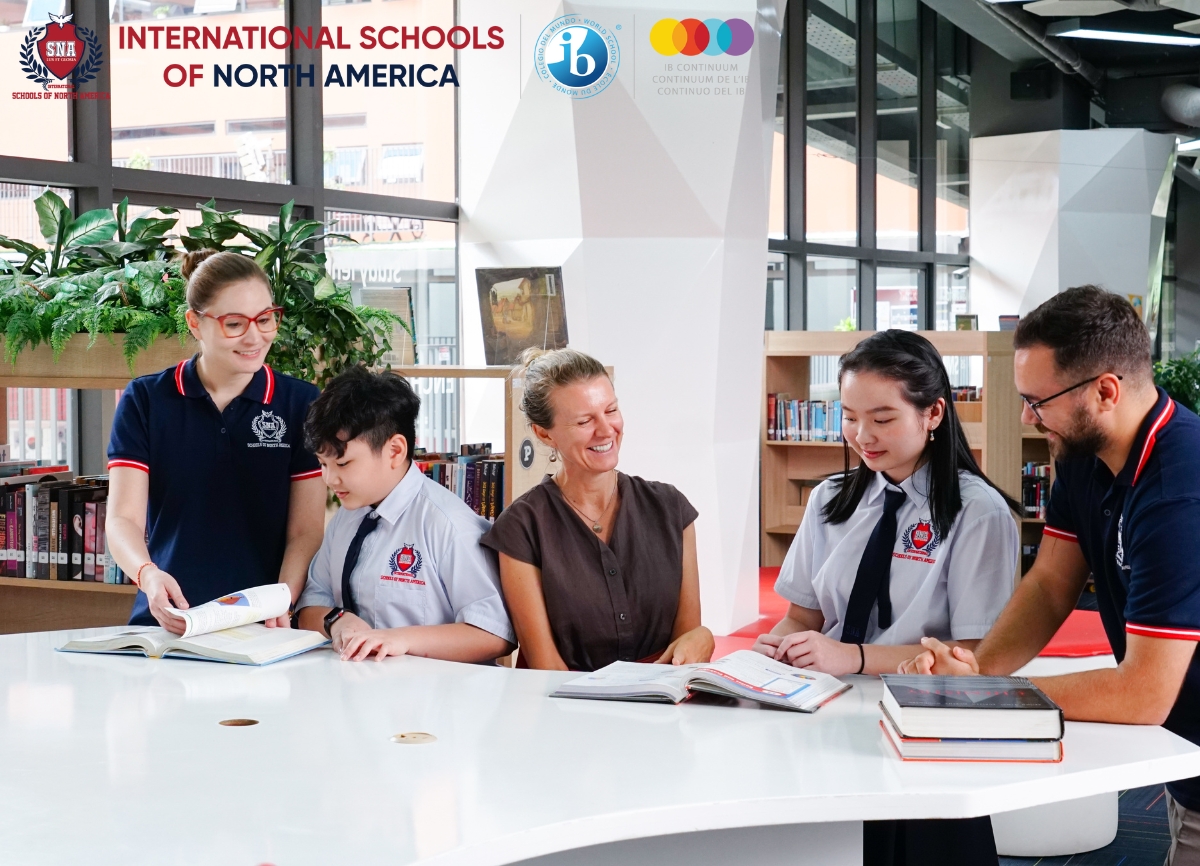
Classrooms are designed to promote interaction, debate, and mutual learning. Teachers do not teach in the traditional “lecture‐copy” manner. They act as facilitators, provoke thinking and ask reverse questions so students actively explore and critique.
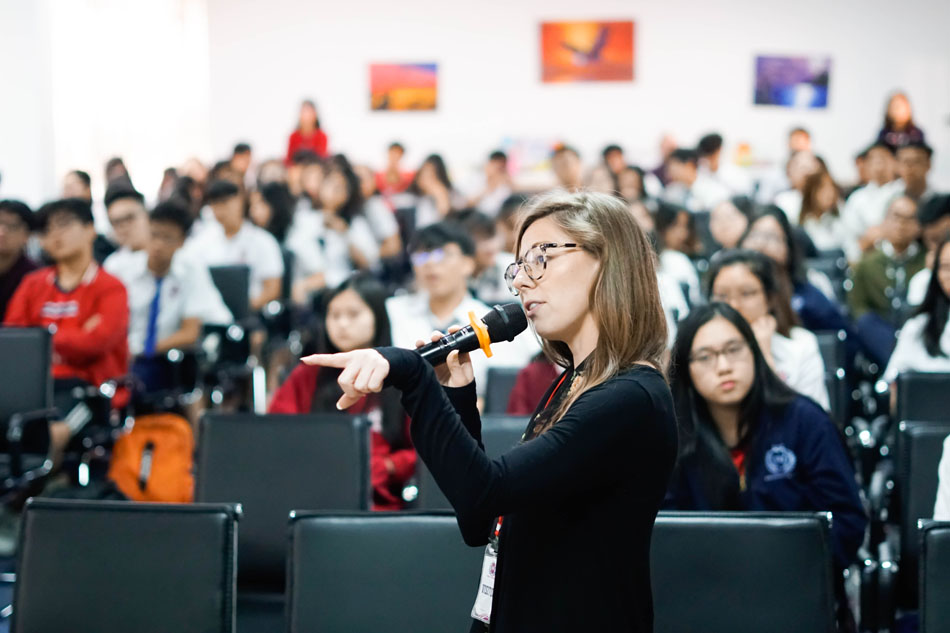
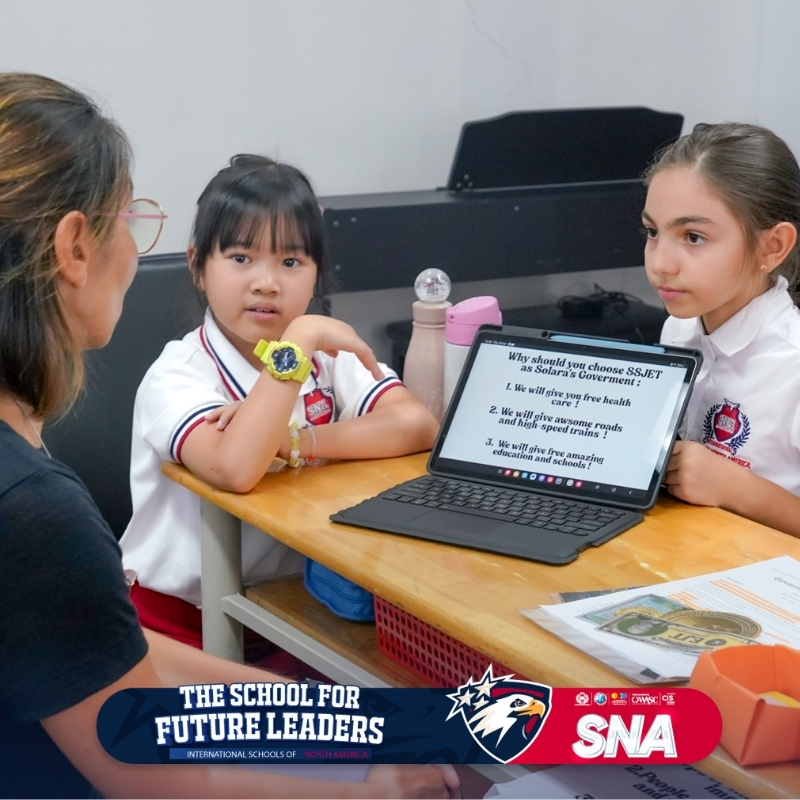
Interdisciplinary projects, debate workshops, United Nations model simulations, academic clubs, or TED‐style presentations are regularly organized so that students practice critical thinking in real environments, building confidence and clear reasoning. - Teachers accompany students at each developmental stage
- At the Primary level (PYP): Teachers encourage students to ask “why”, group discussions, and explore familiar issues via thematic learning projects.
- At the Middle School level (MYP): Students are guided to analyze information, cross‐check multiple sources, and evaluate the credibility of viewpoints.
- At the High School (DP): Teachers focus on essay writing, academic thinking, and independent research – key elements that help students sustainably develop critical thinking for studying abroad and international integration.
- Teachers at SNA are trained according to IB standards, with real experience in designing highly critical thinking learning activities, and know how to design a personalized thinking development path for each student. As a result, every student is supported to reach the level of thinking appropriate to their age and ability.
Frequently Asked Questions
Why do students need to train in critical thinking?
Because it is a foundational skill for effective learning, making correct decisions, and succeeding in modern academic and social settings.
How is critical thinking different from ordinary thinking?
Ordinary thinking may be influenced by emotions, habits, or peer pressure. Critical thinking, on the other hand, relies on reasoning, evidence, and the ability to evaluate objectively.
Does critical thinking make students “argumentative”?
No. On the contrary, students with critical thinking will know how to respond reasonably, with evidence, in a respectful way – not oppose arbitrarily or without control.
What can parents do to help their children develop critical thinking?
Listen to them, ask open‐ended questions, encourage them to explore and formulate their own views, and learn to accept different perspectives. Critical thinking is not only a skill but also a mindset that must be practiced continuously.
By learning to see issues from multiple angles, analyzing facts based on strong reasoning and reliable evidence, you become more confident in all decisions. In the age of exploding information, having critical thinking is the key to mastering knowledge and heading toward sustainable success.